People
Wallace Clement Sabine
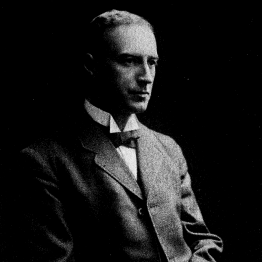

Cite this entry: “Wallace Clement Sabine.” Person. Sound and Science: A Database for Sources in the History of Acoustics. Last modified 23 November 2026. https://soundandscience.net/id/11364.
Wallace Clement Sabine
Sabine was a pioneer of architectural acoustics. He defined the reverberation time and empirically developed its formula, which helped him to predict and optimize the acoustics of large auditoriums such as the Fogg Lecture Hall at Harvard and the Symphony Hall in Boston.
After graduating from Ohio State University aged only eighteen, Sabine pursued graduate studies at Harvard University, where he worked as a young assistant professor in the physics department. Although he was a popular lecturer, Sabine never received his PhD—which may have been one of the reasons that, in 1895, he was assigned the invidious task of acoustically improving the Lecture Hall of the recently opened Fogg Art Museum, something considered an impossible task. Despite having no particular background in sound, Sabine now started research on acoustics. He experimented with the absorption quality of different materials that he and his team moved between the Sanders Theatre and the Fogg Lecture Hall at night, as both rooms were in normal use during the daytime. With an organ pipe and a stopwatch, Sabine measured what he defined as reverberation time—the time required for the intensity of a sound to drop by 60 dB. He discovered a relationship between the size of a chamber, its absorption surface, and the quality of its acoustics, rapidly making a name for himself in the emerging field of architectural acoustics. In 1898, the architectural firm McKim, Mead & White turned to Sabine for advice in the planning of the Symphony Hall in Boston. Using his material from the Fogg Museum experiments, Sabine was able to empirically develop a formula to predict acoustic properties, thus contributing to the construction of what is now regarded as one of the world’s best concert halls. In 1900, he married the physician Jane Downes Kelly, and five years later he was appointed professor of physics at Harvard University. During World War I, Sabine was a member of the National Advisory Committee for Aeronautics. He died in 1919, aged fifty, from complications following surgery for a kidney infection.
Sabine was a member of the American Academy of Arts and Sciences from 1894. The unit of sound absorption, sabin (one square foot of 100% absorbing material has the value of one imperial sabin), is named in his honor.
Key publications:
- Sabine, Wallace Clement. “Architectural Acoustics.” Proceedings of the American Academy of Arts and Sciences 42 (1906–1907): 49–84.
- Sabine, Wallace Clement. “Theatre Acoustics.” The American Architect 104 (1913): 257–279.
- Sabine, Wallace Clement. Collected Papers on Acoustics. Cambridge: Harvard University Press, 1922.
Sources:
- Roberts, Brian. “Wallace Clement Ware Sabine, acoustic pioneer.”
- “Sabine, Wallace Clement Ware.” Complete Dictionary of Scientific Biography. Encyclopedia.com. (July 4, 2018).
- “January 10, 1919: Death of Wallace Sabine, pioneer of architectural acoustics” American Physical Societey News 20, No. 1 (2011)
- National historic landmark nomination of the Boston Symphony Hall
- Objects connected to Sabine in the Collection of Historical Scientific Instruments at Harvard University
Compiled by HE
Cite this entry: “Wallace Clement Sabine.” Person. Sound and Science: A Database for Sources in the History of Acoustics. Last modified 23 November 2026. https://soundandscience.net/id/11364.
Join the Project
To contact us, please write to ofni.ecneicsdnadnuos@tcatnoc




© 2015 – 2026 Humboldt-Universität zu Berlin