Video
Introduction to resonance with artifacts from the National Museum of American History
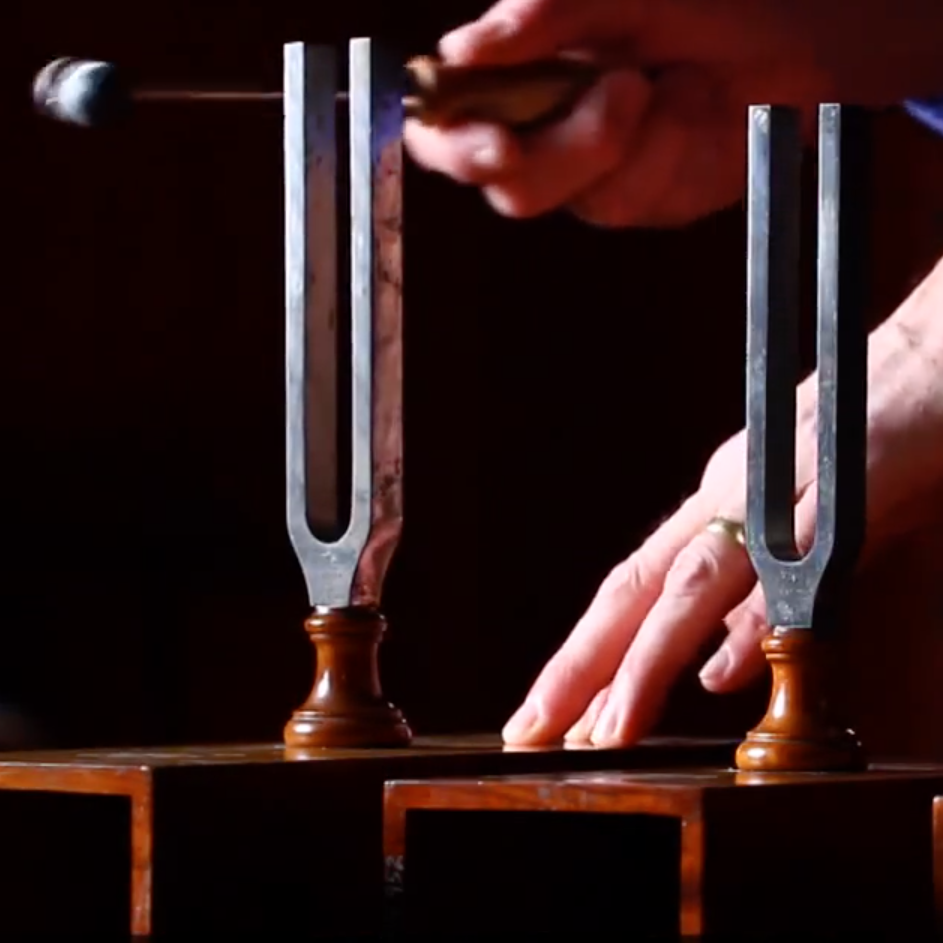
When you play this video, data (including your IP address) is transmitted to YouTube (Google). Google privacy policy

Cite this entry: “Introduction to resonance with artifacts from the National Museum of American History.” Video. Sound and Science: A Database for Sources in the History of Acoustics. Last modified 23 November 2026. https://soundandscience.net/id/13004.
Introduction to resonance with artifacts from the National Museum of American History
Historical Context
In physics the term “resonance” refers to the natural tendency of many objects to vibrate more vigorously at some frequencies than at others. The frequencies at which this occurs are called the object’s “resonance frequencies.”
In acoustics great use has been made of a particular kind of resonance, called air resonance. This occurs when the air in a container is made to vibrate and produce a sound. An example of this is the tone produced when you blow across the top of an empty bottle. As the air in your breath hits the edge of the bottle’s opening it sets up pressure waves in the bottle that, in turn, make the air inside vibrate rapidly and in unison. This rapidly vibrating mass of air is what makes the sound. The shape and size of the container are what determine its’ frequency. Blowing harder or softer only affects how loud it is.
In the 1850s, the German scientist Herman Helmholtz used this principle to create a powerful new scientific instrument – the acoustic “resonator”. It still involved a moving mass of air, but instead of producing a sound, this instrument was used to detect it. Helmholtz was able to design vessels that would only respond to a specific frequency of sound, and would greatly amplify that sound when it was present. Resonators could also extend the time that a tone was sounded, which in an age without microphones or speakers, was an important advancement.
Source: Steven Turner; Curator, Physical Sciences, National Museum of American History, Smithsonian Institution.
Further information on the Science Teaching Collection and the Smithsonian National Museum of American History can be found here.
Cite this entry: “Introduction to resonance with artifacts from the National Museum of American History.” Video. Sound and Science: A Database for Sources in the History of Acoustics. Last modified 23 November 2026. https://soundandscience.net/id/13004.

Join the Project
To contact us, please write to ofni.ecneicsdnadnuos@tcatnoc




© 2015 – 2026 Humboldt-Universität zu Berlin