Video
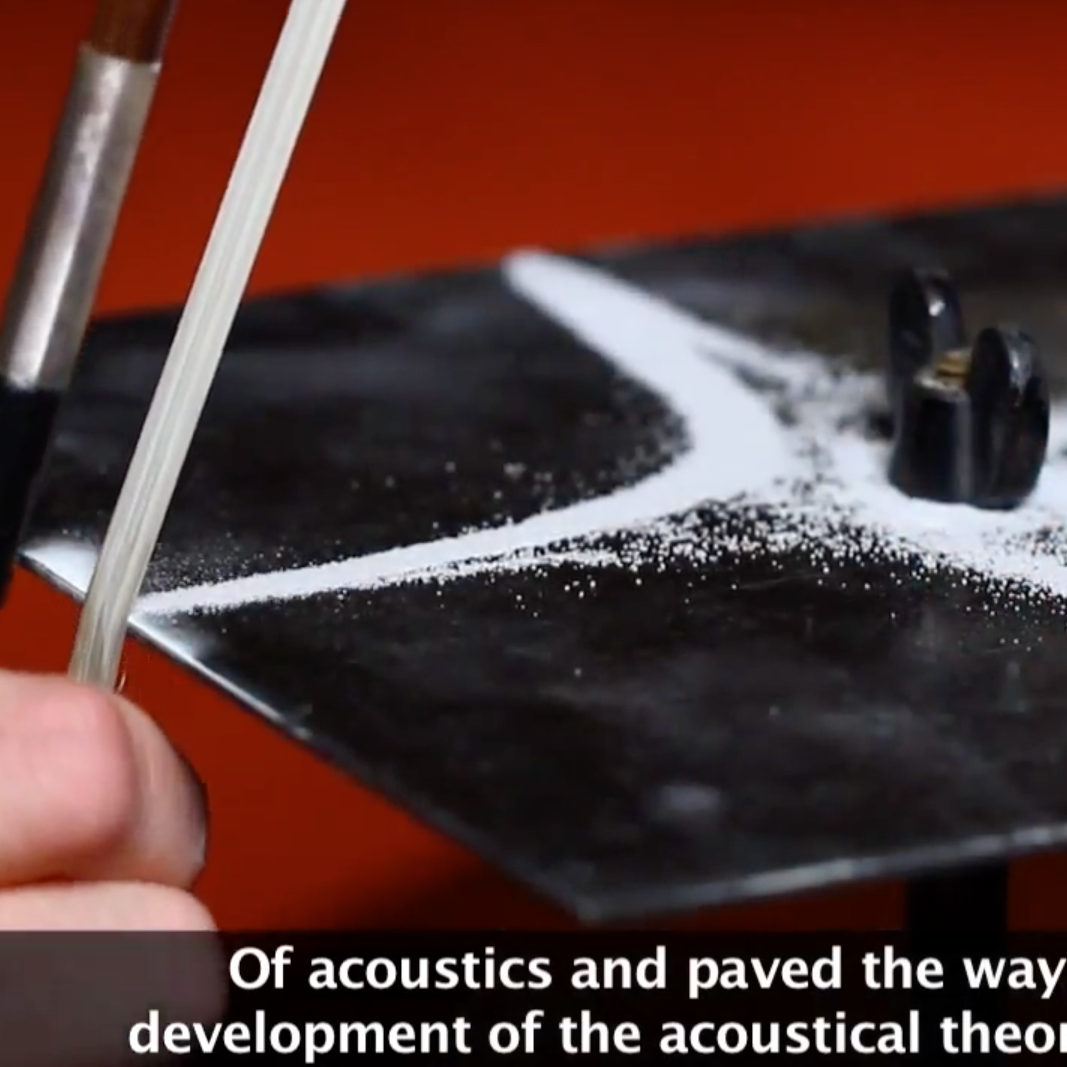
Chladni plate demonstration from the National Museum of American History
When you play this video, data (including your IP address) is transmitted to YouTube (Google). Google privacy policy

Cite this entry: “Chladni plate demonstration from the National Museum of American History.” Video. Sound and Science: A Database for Sources in the History of Acoustics. Last modified 23 November 2026. https://soundandscience.net/id/13006.


Chladni plate demonstration from the National Museum of American History
Historical Context
The German scientist Ernst Chladni was one of the pioneers of experimental acoustics. His research on different kinds of vibrations served as the basis for the scientific understanding of sound that later emerged in the 19th century.
One of Chladni’s inventions was a technique to study the motions of vibrating plates. Starting with a metal plate whose surface had been lightly sprinkled with sand, he found that bowing it produced characteristic patterns that could be related to the physical dimensions of the plate. ‘Chladni’s Plates’, as they came to be called, provided an early way to visualize the effects of vibrations on mechanical surfaces. Chladni was even able to produce a formula that successfully predicted the patterns found on vibrating circular plates. The success of Chladni’s research, combined with the popularity of his many public demonstrations, did much to improve the standing of acoustics during his lifetime, and inspired many of the acoustic researchers who later extended his work.
Once Chladni’s patterns began to be understood, it was found that they could also be used analytically, to provide information about the conditions that formed them. For example, violin makers have long used Chladni figures to provide feedback as they shape the critical front and back plates of the instrument’s resonance box. Fine metal filings are sprinkled on the wooden plates, which are then vibrated (at as many as seven different frequencies) to produce a series of patterns. Much of the final shaping of the plates is directed towards ensuring that the patterns on both of them match and are symmetrical. This symmetry is what allows the resonator to move as a single mass and to produces the richest, most beautiful tones.
Chladni patterns are still of scientific interest, although their analytical uses have been mostly replaced by other technologies. Today these figures are more likely to be produced by a virtual imaging program than by an actual vibrating plate.
Source: Steven Turner; Curator, Physical Sciences, National Museum of American History, Smithsonian Institution.
Further information on the Science Teaching Collection and the Smithsonian National Museum of American History can be found here.
Cite this entry: “Chladni plate demonstration from the National Museum of American History.” Video. Sound and Science: A Database for Sources in the History of Acoustics. Last modified 23 November 2026. https://soundandscience.net/id/13006.

Join the Project
To contact us, please write to ofni.ecneicsdnadnuos@tcatnoc




© 2015 – 2026 Humboldt-Universität zu Berlin