Artefacts
“Vibration of plates”, Science Teaching Collection

Cite this entry: ““Vibration of plates”, Science Teaching Collection.” Artefact. Sound and Science: A Database for Sources in the History of Acoustics. Last modified 23 November 2026. https://soundandscience.net/id/13278.
“Vibration of plates”, Science Teaching Collection
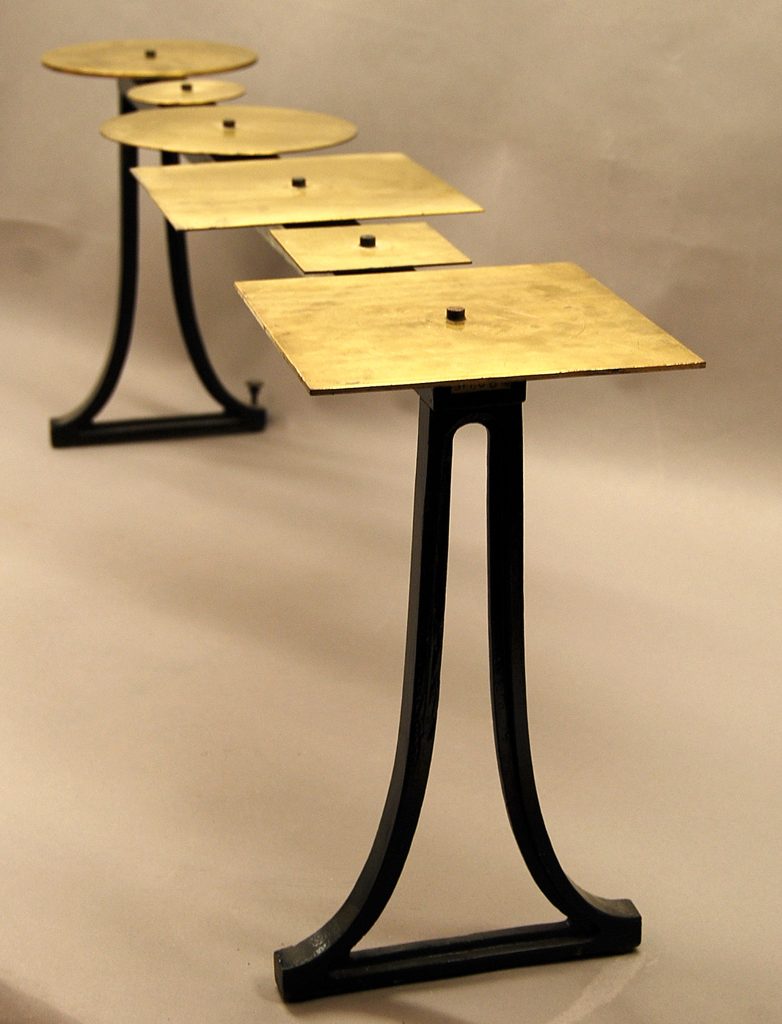
This rack has 3 square and 3 circular brass plates of varying dimensions. It was used to demonstrate the effect of changes in the size and thickness of plates on both their tone and the Chladni figures that they produce. A plate that is the same size as the one next to it, but double the thickness, will produce a note twice as high, while a plate that is half the area of the one next to it, but double the thickness, will sound a note that is four times higher.
Source: Steven Turner; Curator, Physical Sciences, National Museum of American History, Smithsonian Institution.
Cite this entry: ““Vibration of plates”, Science Teaching Collection.” Artefact. Sound and Science: A Database for Sources in the History of Acoustics. Last modified 23 November 2026. https://soundandscience.net/id/13278.

Join the Project
To contact us, please write to ofni.ecneicsdnadnuos@tcatnoc




© 2015 – 2026 Humboldt-Universität zu Berlin