Artefacts
Tone variator

Cite this entry: “Tone variator.” Artefact. Sound and Science: A Database for Sources in the History of Acoustics. Last modified 23 November 2026. https://soundandscience.net/id/13310.
Tone variator
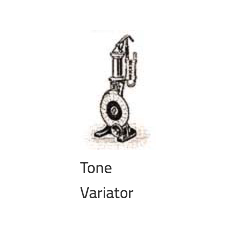
William Stern invented the tone variator in 1897 to study human sensitivity to changes in pitch, going beyond the traditional psychological research of studying the sensitivity to differences in discrete tones. The instrument consists of an adjustable brass resonator (see Helmholtz resonator for more information), which is supplied with a constant flow of air across an opening at the top. Turning a graduated cam on the front of the apparatus raises or lowers a piston in the bottom of the resonator, changing the volume of its interior, thus altering the sounded pitch over a continuous range. The spiral-shaped cam is such that equal angles of rotation approximately correspond to equal changes in frequency. A dial on the front of the cam indicates the current resonant frequency and musical tone of the instrument.

The instrument has been used in demonstrations, for tuning other instruments, and for research in psychology and otology.
Text & figures by Brian Tinker, republished with the kind permission of Case Western Reserve University and William Fickinger, Prof Emeritus of Physics.
Cite this entry: “Tone variator.” Artefact. Sound and Science: A Database for Sources in the History of Acoustics. Last modified 23 November 2026. https://soundandscience.net/id/13310.

Join the Project
To contact us, please write to ofni.ecneicsdnadnuos@tcatnoc




© 2015 – 2026 Humboldt-Universität zu Berlin