Artefacts
Tuning fork

Cite this entry: “Tuning fork.” Artefact. Sound and Science: A Database for Sources in the History of Acoustics. Last modified 23 November 2026. https://soundandscience.net/id/13353.
Tuning fork
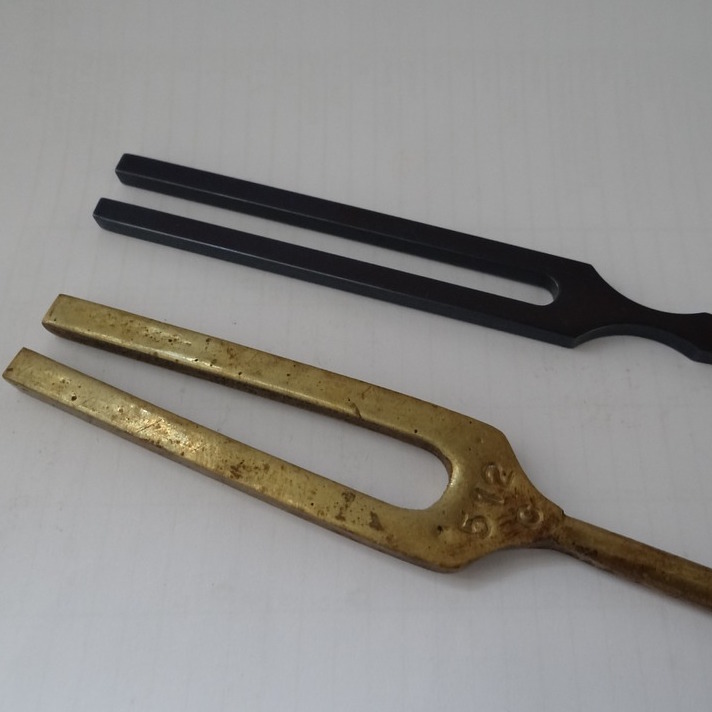
Invented by John Shore in 1711, the tuning fork was initially used by musicians. After Chladni’s studies of its vibrations, however, it was also extensively employed by acousticians, who praised the purity of its sound. Hermann von Helmholtz, especially, based his experiments with beats, combination tones, and simple tones on tuning forks attached to resonators that enhanced their suitability for experimentation. Tuning forks were also used by acousticians as components of the tonometer, an apparatus invented in 1834 by the silk manufacturer Johann Heinrich Scheibler. Based on a combination of more than fifty tuning forks, covering an octave, the tonometer enabled unprecedented precision in instrument tuning. Tuning forks were more than mere tools: they transformed nineteenth-century acousticians’ ways of thinking about sound.
Cite this entry: “Tuning fork.” Artefact. Sound and Science: A Database for Sources in the History of Acoustics. Last modified 23 November 2026. https://soundandscience.net/id/13353.

Join the Project
To contact us, please write to ofni.ecneicsdnadnuos@tcatnoc




© 2015 – 2026 Humboldt-Universität zu Berlin