Artefacts
Phonograph

Cite this entry: “Phonograph.” Artefact. Sound and Science: A Database for Sources in the History of Acoustics. Last modified 23 November 2026. https://soundandscience.net/id/13368.
Phonograph
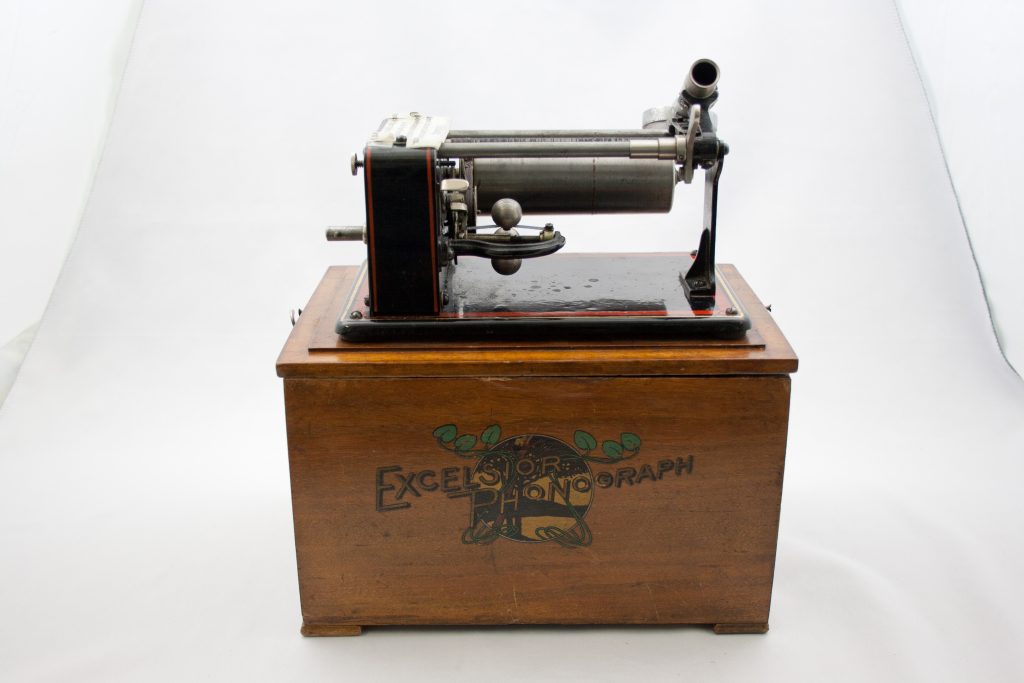
The Edison phonograph (invented in 1877 by Thomas Alva Edison) is an iconic piece of historical sound technology that is universally associated with the beginning of sound reproduction in the late nineteenth century. It is based on the direct transfer of the vibration of air, caused by a sound source, onto a writing surface, then its playback. During recording, a stylus cuts a spiraling groove into the cylinder. For playback, the needle follows the groove to recreate the original vibrations, though with a certain amount of distortion introduced by the specifics of the apparatus and its recording medium. The idea behind the phonograph materialized throughout the nineteenth century in multiple devices by different inventors, in most cases including attempts to make the vibrations of the air visible on a moving medium. Notably, the phonautograph invented by Édouard-Léon Scott de Martinville in the 1850s was able to record visual traces of sound that were accurate enough to enable the reconstruction of the original sound 150 years later.
The technology of the phonograph has undergone a series of incremental changes. Thus, tin foil was used in early experiments but was then replaced by a wax cylinder; later developments include the use of disks or tape (as in the Tefifon) instead of a cylinder.
The Phonogramm-Archiv, a collection of phonograph recordings held by the Ethnological Museum in Berlin and originally connected to the Lautarchiv, a historical collection of disk recordings.
The Tefifon
First Sounds, a research website dedicated to early sound recordings. The project that resulted in the playback of Scott de Martinville’s phonautograph recordings is described here.
Library of Congress Digital Collections: History of the Cylinder Phonograph.
Jonathan Sterne, The Audible Past: Cultural Origins of Sound Reproduction (Durham, NC: Duke University Press, 2003).
Nikita Braguinski
Cite this entry: “Phonograph.” Artefact. Sound and Science: A Database for Sources in the History of Acoustics. Last modified 23 November 2026. https://soundandscience.net/id/13368.

Join the Project
To contact us, please write to ofni.ecneicsdnadnuos@tcatnoc



© 2015 – 2026 Humboldt-Universität zu Berlin