Artefacts
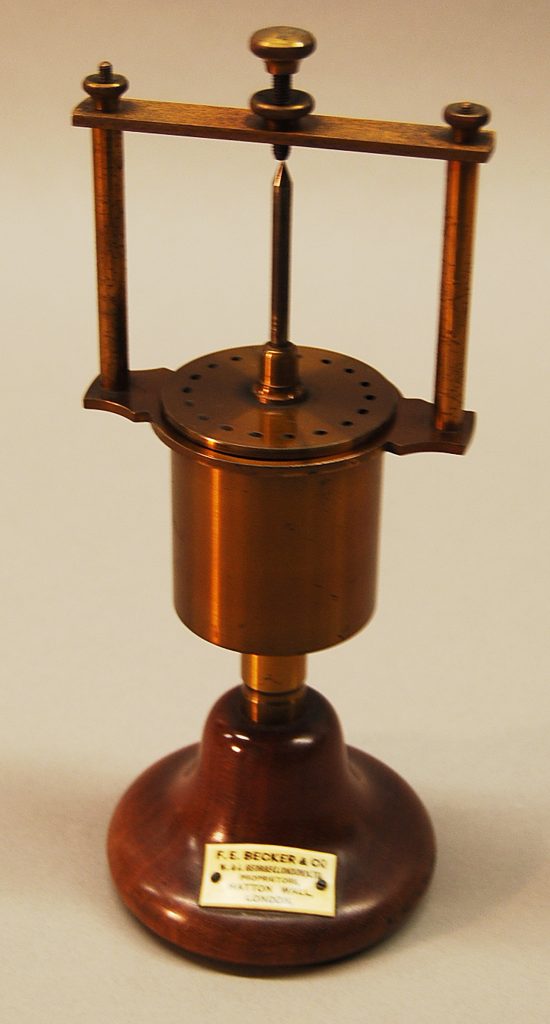
The acoustic siren, Science Teaching Collection
When you play this video, data (including your IP address) is transmitted to YouTube (Google). Google privacy policy

Cite this entry: “The acoustic siren, Science Teaching Collection.” Artefact. Sound and Science: A Database for Sources in the History of Acoustics. Last modified 23 November 2026. https://soundandscience.net/id/13499.
The acoustic siren, Science Teaching Collection
„The acoustic siren was one of the fundamental tools of 19th century science. Invented by the French scientist Cagniard de la Tour, in 1819, the siren used a bellows apparatus to force air through two brass disks. As the air passed through holes in the discs, one of which was rotating, it produced a series of regular pressure waves that we perceive as a musical tone. The construction of the siren allowed that tone to be raised or lowered by simply increasing or decreasing the speed of the rotating disc.
Perhaps the most important feature of de la Tour’s siren were its’ dials. Connected by gears to the shaft of the rotating disk, they recorded the number of times the disk rotated. This was important because simply multiplying the number of rotations per second by the number of holes in the disk gave the precise frequency of the tone being produced. For the first time, scientists were now able to create tones of specific frequencies, and to measure the frequencies of other sounds by comparing them to the measurable sounds of the siren. As acoustic research developed, several important improvements were made to the siren, and it continued to be an important scientific tool into the early 20th century.“
Source: Steven Turner; Curator, Physical Sciences, National Museum of American History, Smithsonian Institution.
Cite this entry: “The acoustic siren, Science Teaching Collection.” Artefact. Sound and Science: A Database for Sources in the History of Acoustics. Last modified 23 November 2026. https://soundandscience.net/id/13499.

Join the Project
To contact us, please write to ofni.ecneicsdnadnuos@tcatnoc



© 2015 – 2026 Humboldt-Universität zu Berlin