Artefacts
Beats apparatus, Science Teaching Collection

Cite this entry: “Beats apparatus, Science Teaching Collection.” Artefact. Sound and Science: A Database for Sources in the History of Acoustics. Last modified 23 November 2026. https://soundandscience.net/id/13260.
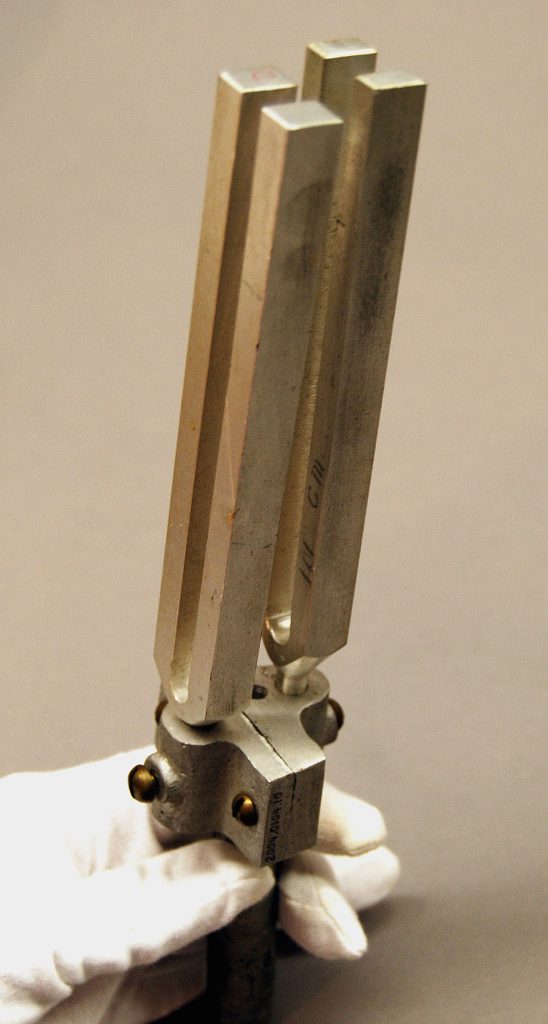
Beats apparatus, Science Teaching Collection
This instrument, made in the 1950s, was designed to demonstrate the acoustic phenomena of “beats”. Beats are produced when two similar sounds interact. If the sound’s frequencies differ by only a few wavelengths, their combined tone will contain rapid changes in loudness. These are the beats, and they are caused by the physical interaction of sound waves as they alternately combine creatively, to increase the sound, and destructively, to reduce it. Beats provided a convenient way to measure sound in the 19th century, because if the frequency of one of the tones was known, counting the number of beats per second would allow a person to precisely calculate the frequency of the second tone. This was the method that Scheibler developed to produce his tonometer (below) and this procedure can be demonstrated with this apparatus.
Source: Steven Turner; Curator, Physical Sciences, National Museum of American History, Smithsonian Institution.
Cite this entry: “Beats apparatus, Science Teaching Collection.” Artefact. Sound and Science: A Database for Sources in the History of Acoustics. Last modified 23 November 2026. https://soundandscience.net/id/13260.

Join the Project
To contact us, please write to ofni.ecneicsdnadnuos@tcatnoc




© 2015 – 2026 Humboldt-Universität zu Berlin