Artefacts
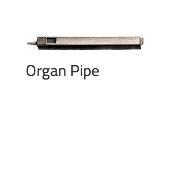
Organ pipe

Cite this entry: “Organ pipe.” Artefact. Sound and Science: A Database for Sources in the History of Acoustics. Last modified 23 November 2026. https://soundandscience.net/id/13324.
Organ pipe
Organ pipes came in a variety of forms, each producing desired overtones.

The pipes used in musical instrument research often feature specific additions for making certain adjustments or performing certain tests. Besides the traditional pipes made of wood, zinc, tin, etc, there were pipes that produced a range of tones by way of an adjustable, graduated piston; pipes with adjustable membranes for producing different vibratory effects; pipes with adjustable holes for the measurement of pressure; pipes for studying the effect of the position of the mouthpiece on the tone; and yet other pipes demonstrating the influence on tone of the volume and shape of the pipe.

An interesting piece in the collection, purchased from Max Kohl of Chemnitz, is called Kundt’s covered pipe (fig. 2). Three glass tubes filled with water allow one to observe the differences in air pressure at various locations inside the pipe. This allows one to locate the positions of the nodes and antinodes of the standing waves.
Text & figures by Brian Tinker, republished with the kind permission of Case Western Reserve University and William Fickinger, Prof Emeritus of Physics.
Cite this entry: “Organ pipe.” Artefact. Sound and Science: A Database for Sources in the History of Acoustics. Last modified 23 November 2026. https://soundandscience.net/id/13324.

Join the Project
To contact us, please write to ofni.ecneicsdnadnuos@tcatnoc




© 2015 – 2026 Humboldt-Universität zu Berlin