Artefacts
Tone bars

Cite this entry: “Tone bars.” Artefact. Sound and Science: A Database for Sources in the History of Acoustics. Last modified 23 November 2026. https://soundandscience.net/id/13305.
Tone bars
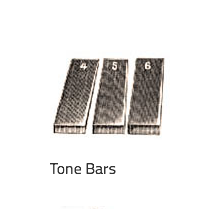
Wooden sticks, when dropped on the floor, sound a variety of tones. While the bars of a xylophone are varied in tone by changing their length, these “tone bars” are all of the same length and width, but have different thicknesses and different densities and elastic properties.


When a bar strikes the floor, the restoring forces of the wood cause the bar to flex back and forth.
The fundamental vibrational mode has a wavelength (λ) approximately twice the length (L) of the bar: λ ≈ 2L. The fundamental frequency is f = v / l, where v is the speed of sound in the wood. The value of v depends on the Young’s modulus (how springy the wood is) and r, the density per unit length (how much mass gets moved around) : v = sqrt(Y/r).
More complicated analysis shows that nodes for the fundamental mode occur about one quarter of the way in from each end; in reality, 22.4% from the ends.
Fundamental: f1 ≈ 1.028 (a/L2) √(Y/ρ)
Harmonics: fn ≈ 0.441 (n + 0.5)2 f1

Text, picture & figures by Brian Tinker, republished with the kind permission of Case Western Reserve University and William Fickinger, Prof Emeritus of Physics.
Cite this entry: “Tone bars.” Artefact. Sound and Science: A Database for Sources in the History of Acoustics. Last modified 23 November 2026. https://soundandscience.net/id/13305.

Join the Project
To contact us, please write to ofni.ecneicsdnadnuos@tcatnoc




© 2015 – 2026 Humboldt-Universität zu Berlin