Artefacts
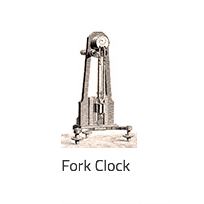
Tuning fork clock

Cite this entry: “Tuning fork clock.” Artefact. Sound and Science: A Database for Sources in the History of Acoustics. Last modified 23 November 2026. https://soundandscience.net/id/13307.
Tuning fork clock
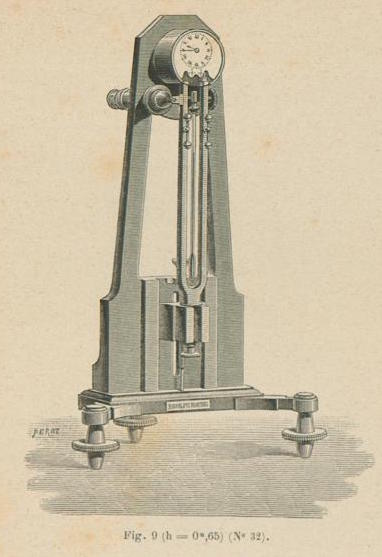
The fork-clock was first described by N. Niaudet in 1866. It is used to determine the frequency of a fork to high accuracy. The vibrating fork drives the clock in the same way as a pendulum in a pendulum clock–by way of an escapement mechanism. This Max Kohl clock uses a 100 Hz fork to drive a tiny escapement. Energy is provided by an enclosed wind-up spring. The three dials record the total number of vibrations. The absolute frequency of the fork can then be determined by comparison with an astronomical time standard.

The frequency of the fork can be fine-tuned by adjustments of small weights on the tines. A small mirror on one prong can be used as in the vibration microscope to calibrate a second fork.
Forks like this were used not only in acoustics research, but as laboratory tools for the precise measurement of time. For example, A. A. Michelson used such a fork to determine the rate of rotation of a spinning mirror in his historic measurement of the speed of light in 1882.
Text & figures by Brian Tinker, republished with the kind permission of Case Western Reserve University and William Fickinger, Prof Emeritus of Physics.
Cite this entry: “Tuning fork clock.” Artefact. Sound and Science: A Database for Sources in the History of Acoustics. Last modified 23 November 2026. https://soundandscience.net/id/13307.

Join the Project
To contact us, please write to ofni.ecneicsdnadnuos@tcatnoc




© 2015 – 2026 Humboldt-Universität zu Berlin