Video
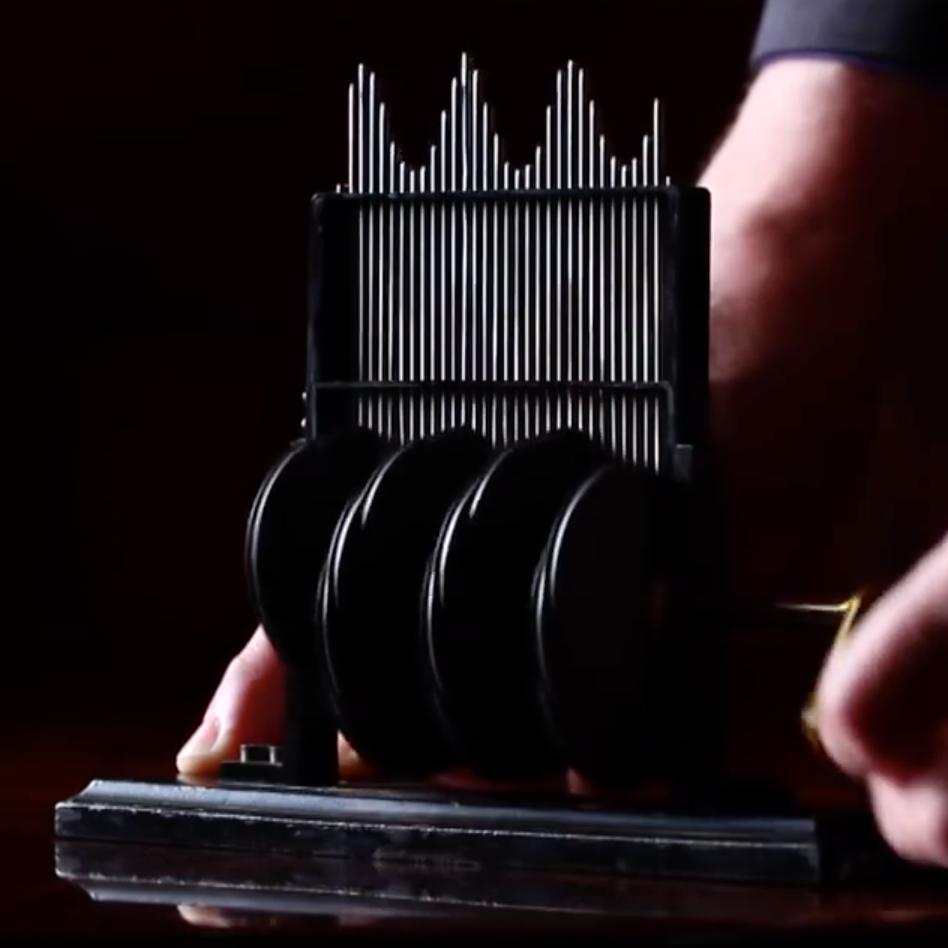
Introduction to wave models from the National Museum of American History
When you play this video, data (including your IP address) is transmitted to YouTube (Google). Google privacy policy

Cite this entry: “Introduction to wave models from the National Museum of American History.” Video. Sound and Science: A Database for Sources in the History of Acoustics. Last modified 23 November 2026. https://soundandscience.net/id/13000.
Introduction to wave models from the National Museum of American History
Historical context
Wave machines and wave models began to appear in science classrooms around the middle of the 19th century. They were used to teach the principles of waves, which were central to a new understanding of the physical world that we now refer to as “classical physics.” Classical physics was a synthesis of many subjects – acoustics, heat, light and, later, electricity and even magnetism – all of which could be explained in terms of different kinds of waves. Teaching the principles of waves thus became one of the basic goals of the science classroom. And since most waves are too rapid to see directly, a variety of wave models and machines were developed to depict them.
Compared to other kinds of waves, sound waves are relatively simple and can used to demonstrate nearly all the properties of waves. They can also be represented as being either longitudinal (like a pressure wave) or transverse (like the up and down waves on a vibrating string). Because of this, acoustics was commonly the first topic that students studied, and a wide range of demonstration models were developed to assist them.
Wave machines were widely used until the early 20th century, when a series of important discoveries were made that could not be explained by wave phenomena alone. Although waves continued to be important in many fields, light and other forms of electromagnetic radiation were now explained in terms of sub-atomic particles and wave packets. The age of classic physics was over and wave machines began to slowly disappear from the science classroom.
Source: Steven Turner; Curator, Physical Sciences, National Museum of American History, Smithsonian Institution.
Further information on the Science Teaching Collection and the Smithsonian National Museum of American History can be found here.
Cite this entry: “Introduction to wave models from the National Museum of American History.” Video. Sound and Science: A Database for Sources in the History of Acoustics. Last modified 23 November 2026. https://soundandscience.net/id/13000.

Join the Project
To contact us, please write to ofni.ecneicsdnadnuos@tcatnoc




© 2015 – 2026 Humboldt-Universität zu Berlin