Artefacts
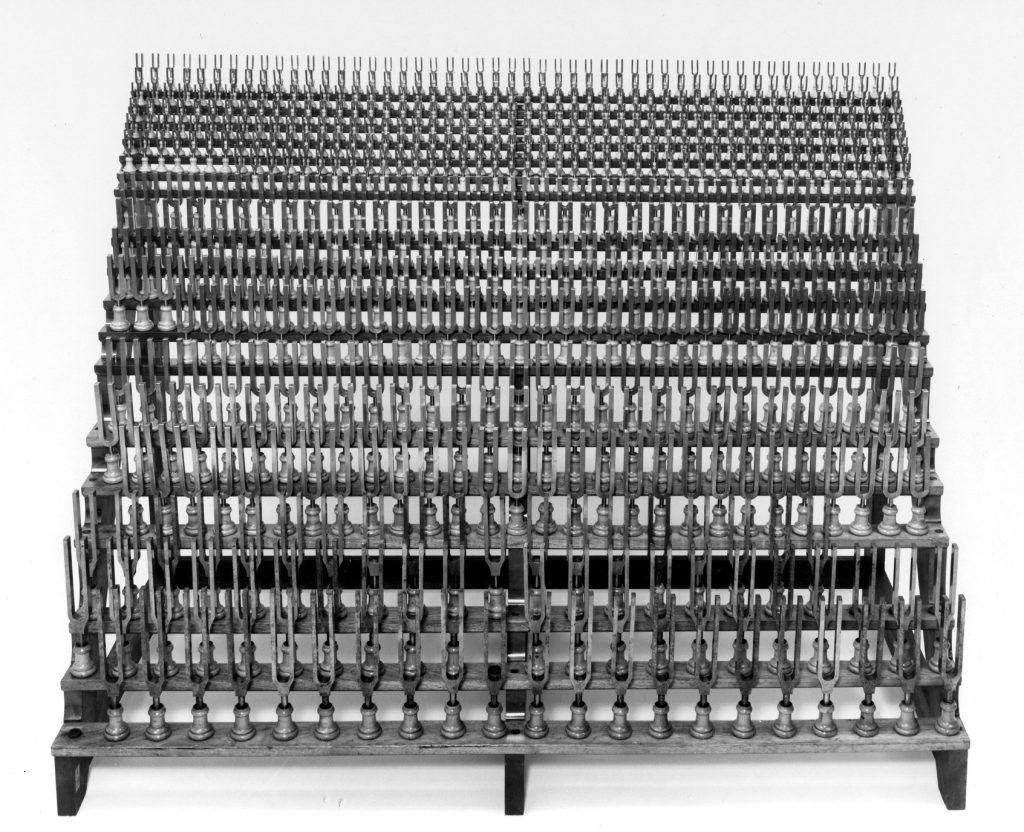
Tonometer, Science Teaching Collection

Cite this entry: “Tonometer, Science Teaching Collection.” Artefact. Sound and Science: A Database for Sources in the History of Acoustics. Last modified 23 November 2026. https://soundandscience.net/id/13262.
Tonometer, Science Teaching Collection
A “Tonometer” is a carefully constructed set of tuning forks which were used, by comparison, to determine the pitch of other sounds. It was the German silk manufacturer (and acoustic researcher) Johann Scheibler who first suggested this instrument, in 1834, and it was he who built the first one.
Scheibler constructed many tonometers during his life, and different sets would have different numbers of tuning forks. His most advanced design consisted of 56 forks, which together covered the range of a single octave (from A220 to A440) at 4 wavelength intervals.
In 1876 the acoustic instrument maker Rudolph Koenig expanded the idea of a tonometer from a single octave to the entire range of human hearing. He constructed a tonometer of 670 tuning forks which ranged in pitch from 16 to 4,096 hertz. Because of the difficulty in producing tiny tuning forks, sounds above that frequency were produced by rubbing precisely made steel rods with a rosined cloth. Koenig’s great tonometer was exhibited at the Philadelphia Exposition of 1876 and was widely regarded by American scientists as the most scientifically important instrument at the event.
Source: Steven Turner; Curator, Physical Sciences, National Museum of American History, Smithsonian Institution.
Cite this entry: “Tonometer, Science Teaching Collection.” Artefact. Sound and Science: A Database for Sources in the History of Acoustics. Last modified 23 November 2026. https://soundandscience.net/id/13262.

Join the Project
To contact us, please write to ofni.ecneicsdnadnuos@tcatnoc




© 2015 – 2026 Humboldt-Universität zu Berlin