Artefacts
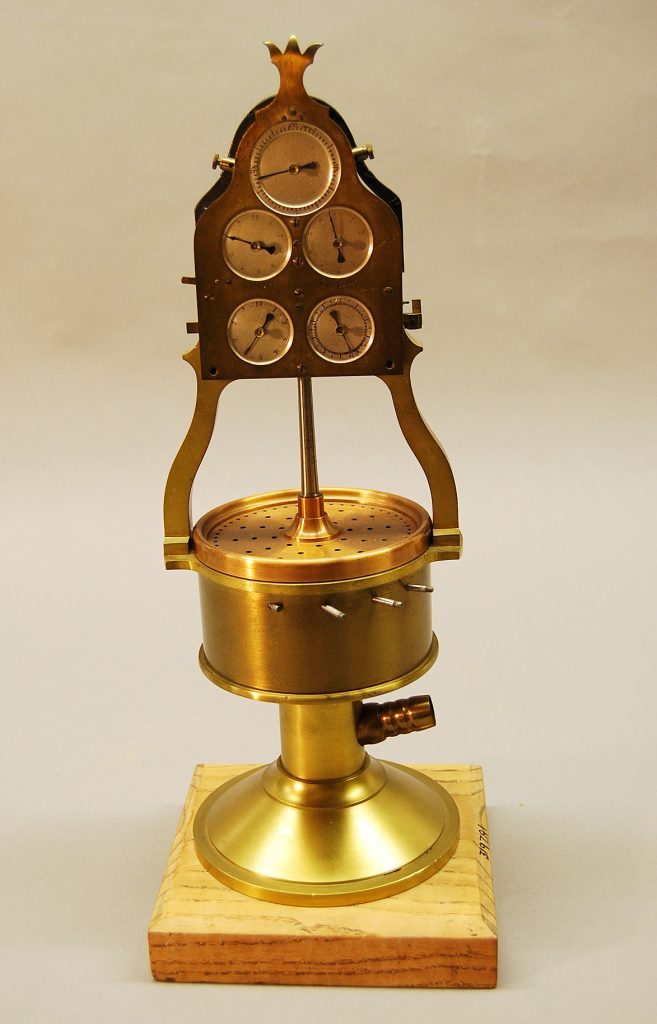
Dove’s siren, Science Teaching Collection

Cite this entry: “Dove’s siren, Science Teaching Collection.” Artefact. Sound and Science: A Database for Sources in the History of Acoustics. Last modified 23 November 2026. https://soundandscience.net/id/13264.
Dove’s siren, Science Teaching Collection
Around 1840, the Prussian scientist Heinrich Wilhelm Dove invented a new type of siren, designed to produce several tones at once. Unlike the disks in de la Tour’s siren, which only had one ring of holes, the disks in Dove’s siren featured four rings, each with a different number of holes. Four stops mounted below the disks allowed the user to “play” whichever tone, or combination of tones, was desired by simply pulling out the appropriate stop. The five dials on the top of the siren facilitated measuring multiple frequencies.
Dove invented this instrument around the time that he discovered binaural beats, a perceptual artifact produced when tones of slightly different frequencies are heard in different ears. This siren was ideal for that kind of research, as well as for demonstrating interference effects (where sound waves combine to increase or diminish) and for combination tones.
Source: Steven Turner; Curator, Physical Sciences, National Museum of American History, Smithsonian Institution.
Cite this entry: “Dove’s siren, Science Teaching Collection.” Artefact. Sound and Science: A Database for Sources in the History of Acoustics. Last modified 23 November 2026. https://soundandscience.net/id/13264.

Join the Project
To contact us, please write to ofni.ecneicsdnadnuos@tcatnoc




© 2015 – 2026 Humboldt-Universität zu Berlin