Artefacts
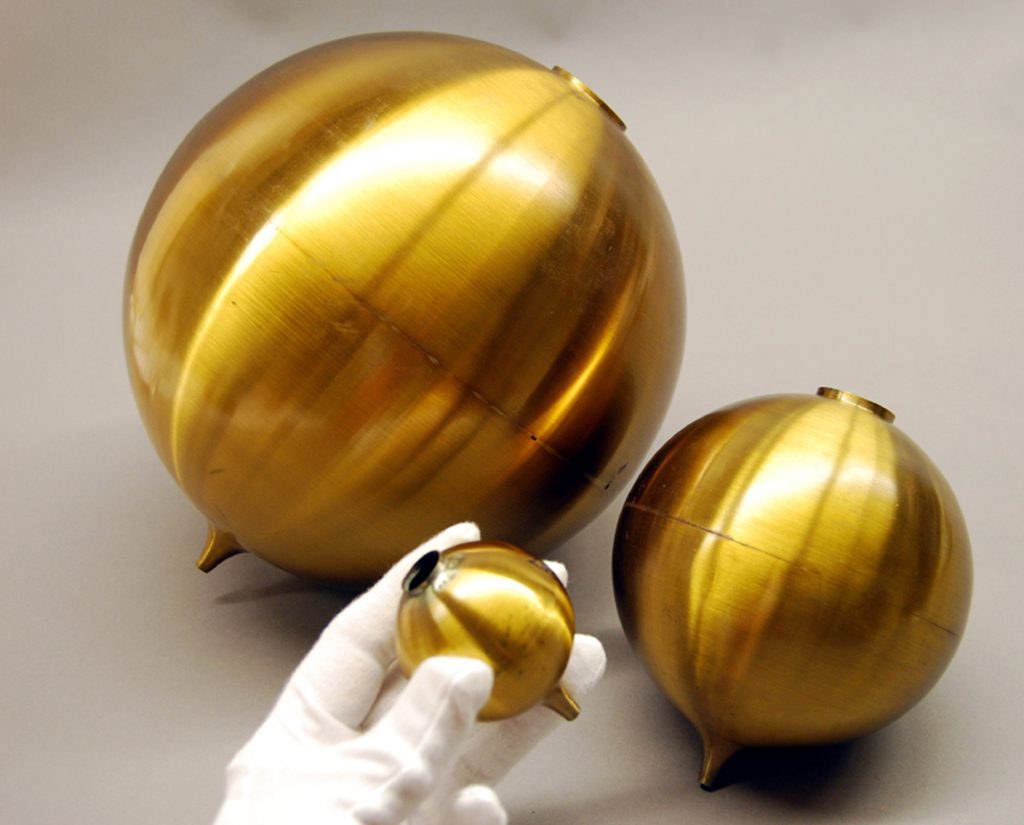
Resonators from Helmholtz, Science Teaching Collection

Cite this entry: “Resonators from Helmholtz, Science Teaching Collection.” Artefact. Sound and Science: A Database for Sources in the History of Acoustics. Last modified 23 November 2026. https://soundandscience.net/id/13268.

Resonators from Helmholtz, Science Teaching Collection
This is a set of 16 Helmholtz resonators. Made from sections of brass that were spun on a lathe, they are wonderfully light and easy to hold. Helmholtz designed them to demonstrate his theory that all vowel and musical sounds are composed of combinations of simple, pure notes (Helmholtz’s “Theory of Timbre”). He correctly observed that musical sounds, particularly the higher tones, are often perceived as a single mass of sound. But with these resonators, even people with no musical training could easily pick out the simple, pure tones, even when they were faint and mixed with other sounds.
Each resonator was carefully tuned to respond to only a single frequency. For the person using it, the resonance would occur quite suddenly, with an unmistakable amplification of a particular sound. To use these resonators, the small end was inserted directly into the ear and sealed with a bit of warm wax. The other ear was also sealed with a wax plug. Once this was done, Helmholtz wrote: ‘most of the tones produced in the surrounding air will be considerably damped; but if the proper tone of the resonator is sounded, it brays into the ear most powerfully.
Source: Steven Turner; Curator, Physical Sciences, National Museum of American History, Smithsonian Institution.
Cite this entry: “Resonators from Helmholtz, Science Teaching Collection.” Artefact. Sound and Science: A Database for Sources in the History of Acoustics. Last modified 23 November 2026. https://soundandscience.net/id/13268.

Join the Project
To contact us, please write to ofni.ecneicsdnadnuos@tcatnoc




© 2015 – 2026 Humboldt-Universität zu Berlin