Artefacts
Savart’s bell and resonator, Science Teaching Collection

Cite this entry: “Savart’s bell and resonator, Science Teaching Collection.” Artefact. Sound and Science: A Database for Sources in the History of Acoustics. Last modified 23 November 2026. https://soundandscience.net/id/13270.
Savart’s bell and resonator, Science Teaching Collection
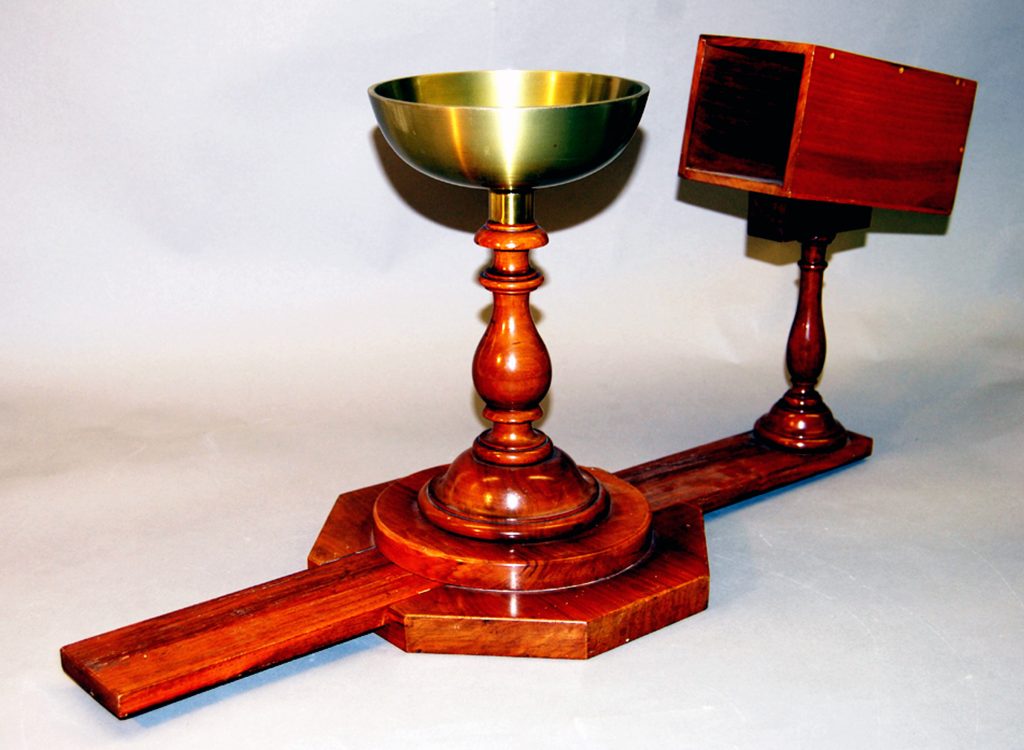
In the second quarter of the 19th century, the French scientist Felix Savart invented this apparatus to demonstrate resonance. It consists of a “bell” (or brass bowl) and a moveable wooden resonator. In the demonstration the bell was activated by being either bowed or struck. As the bell rang, its’ loudness could be increased or diminished by moving the resonator closer or further away. When the sound of the bell became barely audible an effective demonstration was to quickly move the resonator right next to it. The increase in loudness – the ‘resonant effect’ – was striking.
Source: Steven Turner; Curator, Physical Sciences, National Museum of American History, Smithsonian Institution.
Cite this entry: “Savart’s bell and resonator, Science Teaching Collection.” Artefact. Sound and Science: A Database for Sources in the History of Acoustics. Last modified 23 November 2026. https://soundandscience.net/id/13270.

Join the Project
To contact us, please write to ofni.ecneicsdnadnuos@tcatnoc




© 2015 – 2026 Humboldt-Universität zu Berlin