Artefacts
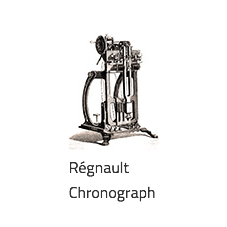
Régnault chronograph

Cite this entry: “Régnault chronograph.” Artefact. Sound and Science: A Database for Sources in the History of Acoustics. Last modified 23 November 2026. https://soundandscience.net/id/13318.
Régnault chronograph
In 1868, Henri-Victor Régnault described an apparatus for determining the speed of sound, capable of accurately measuring time intervals to fractions of a second.

Reels of 2 cm wide paper tape were prepared by cranking them over a smoky camphor candle (see fig. 2). The sooty paper tape was then placed in the chronograph so that marks from three metal styli could be scratched onto the smoked surface. One stylus, attached to a standard electrically driven tuning fork, laid down a continuous trace of a sine wave. The other two styli were driven by electrical on and off signals. The time interval between the on and the off signals was easily determined by counting the number of sine waves between them. The method was thus independent of the rate at which the paper was cranked through the device.

Régnault used the device to determine the speed of sound. In Paris underground tunnels up to 5 km long he ran wires to carry electrical signals from a sound producer and a sound receiver to his device.
Text & figures by Brian Tinker, republished with the kind permission of Case Western Reserve University and William Fickinger, Prof Emeritus of Physics.
Cite this entry: “Régnault chronograph.” Artefact. Sound and Science: A Database for Sources in the History of Acoustics. Last modified 23 November 2026. https://soundandscience.net/id/13318.

Join the Project
To contact us, please write to ofni.ecneicsdnadnuos@tcatnoc




© 2015 – 2026 Humboldt-Universität zu Berlin