Artefacts
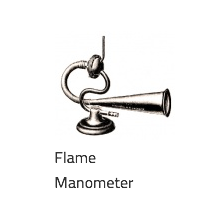
Flame manometer

Cite this entry: “Flame manometer.” Artefact. Sound and Science: A Database for Sources in the History of Acoustics. Last modified 23 November 2026. https://soundandscience.net/id/13320.

Flame manometer
The manometric flame apparatus was developed by Rudolph Koenig in 1862, and was used throughout the field of acoustics prior to the 20th-century advancement of more precise methods of examining the shape of sound waves, such as the phonodeik or modern oscilloscopes.

In this device, a sound wave is captured by a cone, which connects to one side of an enclosed capsule. The capsule is bisected by a rubber diaphragm. On the other side, flammable gas is flowing upward to supply the flame. The rubber diaphragm acts as a modulator for the gas flow, causing the height of the flame to change with the pressure variations in the sound.

The collection of letters of the Department of Physics, Case Western Reserve University, contains a letter from Rudolph Koenig to A. A. Michelson, 1883, explaining (in French) how to replace the rubber membrane inside the flame manometer.

Text & figures by Brian Tinker, republished with the kind permission of Case Western Reserve University and William Fickinger, Prof Emeritus of Physics.
Cite this entry: “Flame manometer.” Artefact. Sound and Science: A Database for Sources in the History of Acoustics. Last modified 23 November 2026. https://soundandscience.net/id/13320.

Join the Project
To contact us, please write to ofni.ecneicsdnadnuos@tcatnoc




© 2015 – 2026 Humboldt-Universität zu Berlin