Artefacts
Vacuum tube mixing console

Cite this entry: “Vacuum tube mixing console.” Artefact. Sound and Science: A Database for Sources in the History of Acoustics. Last modified 23 November 2026. https://soundandscience.net/id/13363.
Vacuum tube mixing console
Date of construction: ca. 1961
A mixing console is a device used to combine a number of inputs, carrying individual parts of the performance, into a predefined output format. Most notably, the console is used in studio recording to create the stereo signal containing two channels of audio. Other uses of a console include live sound in concerts and other public presentations. Since the beginning of their widespread use, in 1960s recording studios, mixing consoles have followed the general trend of technological development in electronics, moving from vacuum tube technology to transistors, then later to digital formats and computer-based approaches.
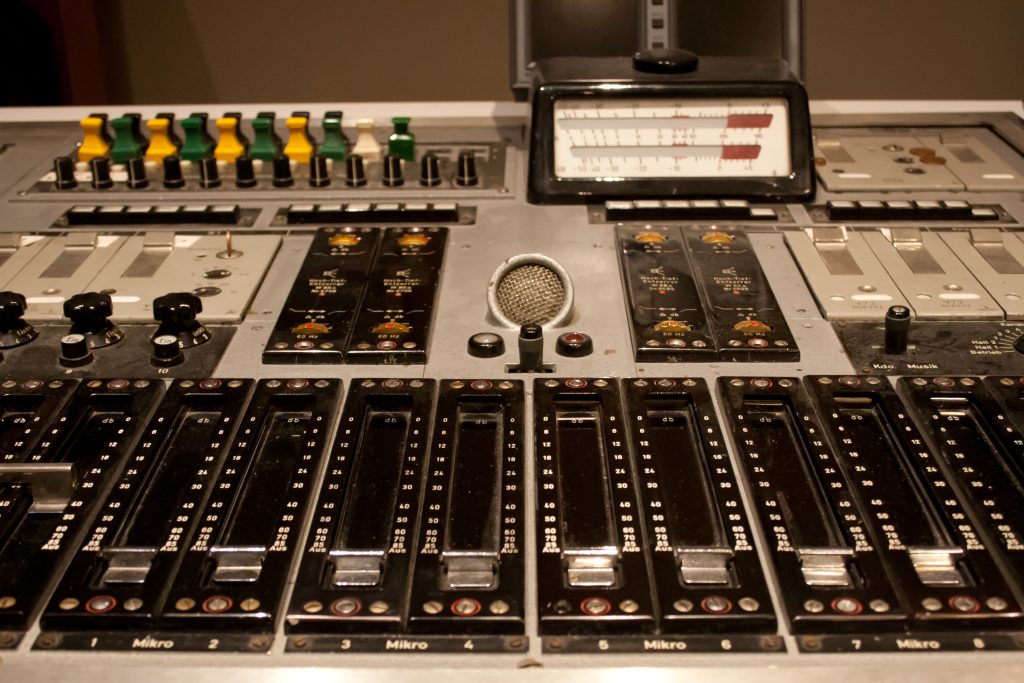
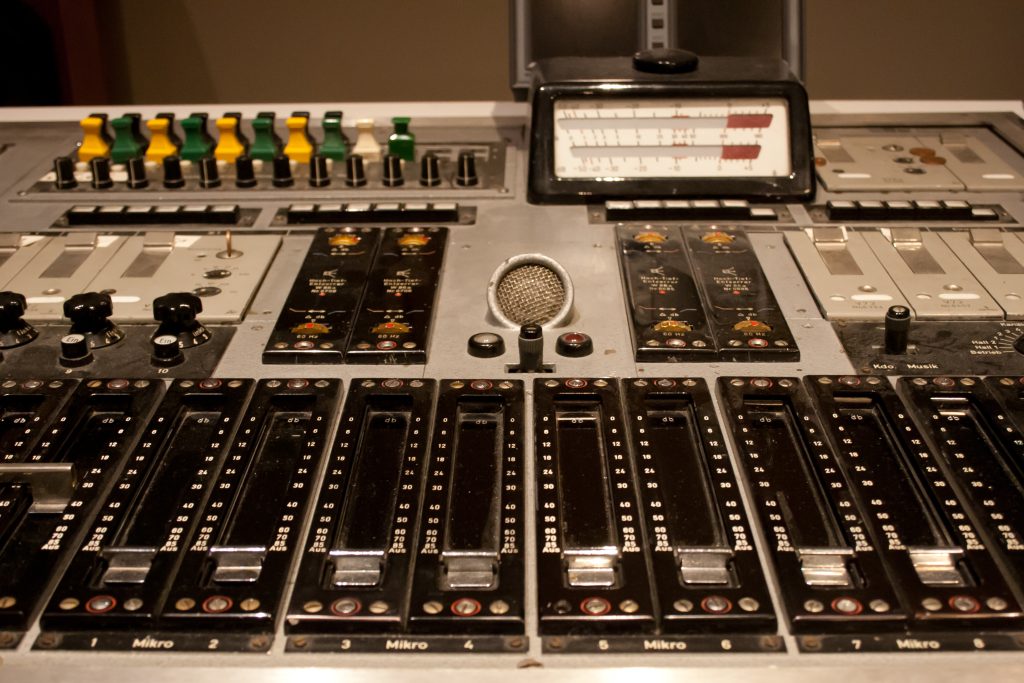
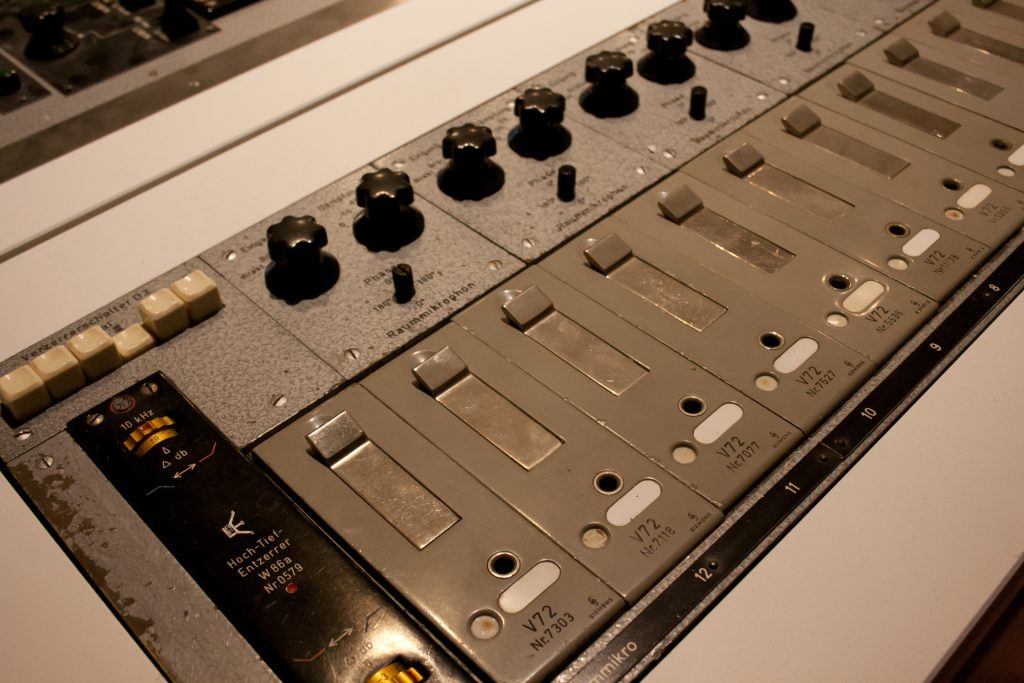
This vacuum tube mixing console is now part of the analog recording facilities of the Emil Berliner Studios in Berlin. According to Rainer Maillard, who heads the studio, this console was used between approximately 1961 and 1971 by the German company Deutsche Grammophon for recording classical music. It was one of only six such consoles used by Deutsche Grammophon at that time. It is still in working condition.
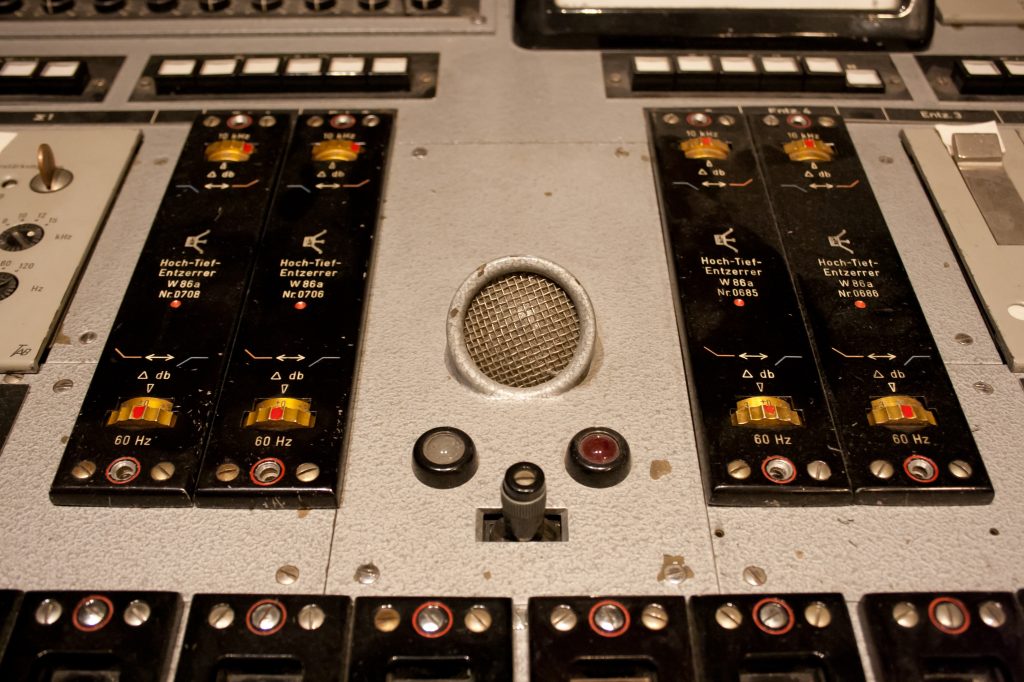
Of this console’s twelve inputs, only six (channels 7 through 12) can be assigned freely between the left and right channel of the stereo signal, so as to position the source in the resulting recording. The sound of four channels can be manipulated by an equalizer, a device allowing the relative loudness of individual parts of the sound spectrum to be adjusted. In this console, each equalizer can affect the frequencies around 10 kHz and 60 Hz. Compared to later technology, these features may appear as limiting because of the small number of channels and the constraints on sound adjustment. However, as examples of still functioning studio technology of their era, such consoles are a valuable source of information. They enable us to understand the gradually disappearing practical knowledge that was involved in the creation of analog recordings in the past.
The analog recording facilities of the Emil Berliner Studios in Berlin
Nikita Braguinski
Cite this entry: “Vacuum tube mixing console.” Artefact. Sound and Science: A Database for Sources in the History of Acoustics. Last modified 23 November 2026. https://soundandscience.net/id/13363.

Join the Project
To contact us, please write to ofni.ecneicsdnadnuos@tcatnoc




© 2015 – 2026 Humboldt-Universität zu Berlin