Artefacts
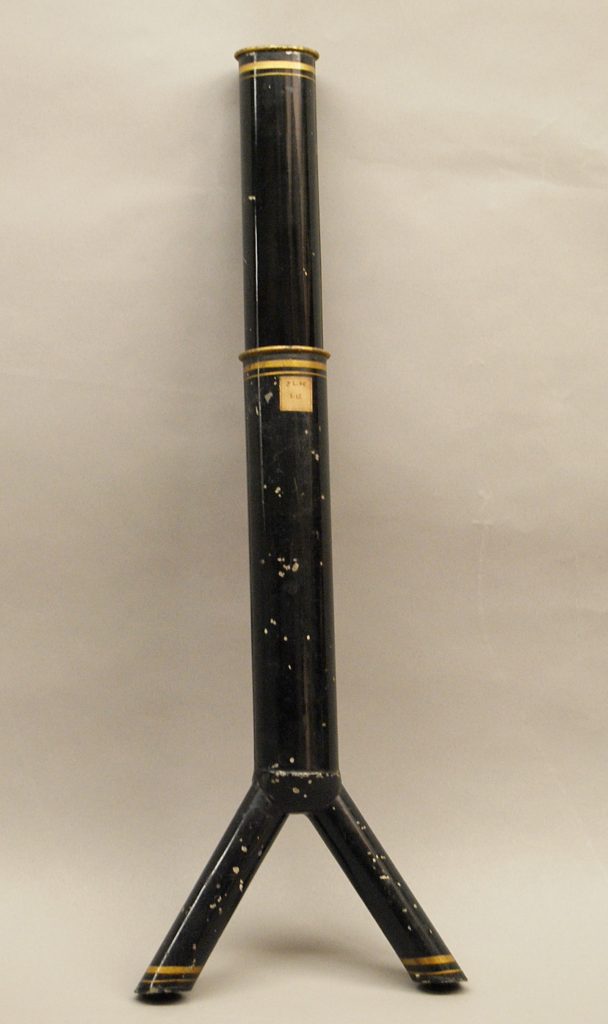
“Forked tube”, Science Teaching Collection

Cite this entry: ““Forked tube”, Science Teaching Collection.” Artefact. Sound and Science: A Database for Sources in the History of Acoustics. Last modified 23 November 2026. https://soundandscience.net/id/13280.
“Forked tube”, Science Teaching Collection
This kind of fork-shaped tube was used to study the motions of different parts of a vibrating Chladni plate. If the ends of the tube were held over two zones that were vibrating in the same direction, a sound would be heard, but if the vibrations were in opposite directions they would cancel each other out (interfere) and the sound would be greatly reduced.
Source: Steven Turner; Curator, Physical Sciences, National Museum of American History, Smithsonian Institution.
Cite this entry: ““Forked tube”, Science Teaching Collection.” Artefact. Sound and Science: A Database for Sources in the History of Acoustics. Last modified 23 November 2026. https://soundandscience.net/id/13280.

Join the Project
To contact us, please write to ofni.ecneicsdnadnuos@tcatnoc




© 2015 – 2026 Humboldt-Universität zu Berlin