Artefacts
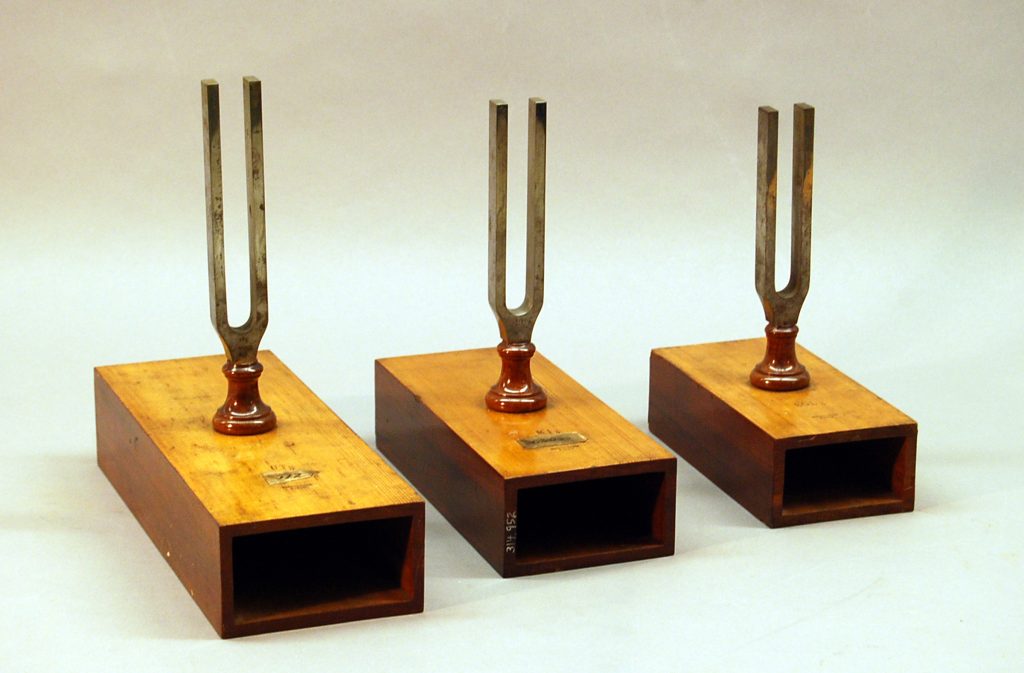
Tuning forks on resonators, Science Teaching Collection

Cite this entry: “Tuning forks on resonators, Science Teaching Collection.” Artefact. Sound and Science: A Database for Sources in the History of Acoustics. Last modified 23 November 2026. https://soundandscience.net/id/13258.
Tuning forks on resonators, Science Teaching Collection
This set of 3 tuning forks, each mounted on its’ own resonator box, was made in Paris between about 1870 and 1900. The tuning forks were each milled from a single blank of fine steel and were then precisely tuned to produce a single, specific, tone. The resonator boxes that they are bolted to are wood, made from the same spruce often used in stringed musical instruments. Spruce wood is naturally responsive to sound vibrations and is the ideal material for this application. Its’ use in these acoustic instruments reminds us that Rudolph Koenig, the great 19th century acoustic instrument maker who manufactured them, was originally trained as a musical instrument maker.
Source: Steven Turner; Curator, Physical Sciences, National Museum of American History, Smithsonian Institution.
Cite this entry: “Tuning forks on resonators, Science Teaching Collection.” Artefact. Sound and Science: A Database for Sources in the History of Acoustics. Last modified 23 November 2026. https://soundandscience.net/id/13258.

Join the Project
To contact us, please write to ofni.ecneicsdnadnuos@tcatnoc




© 2015 – 2026 Humboldt-Universität zu Berlin