People
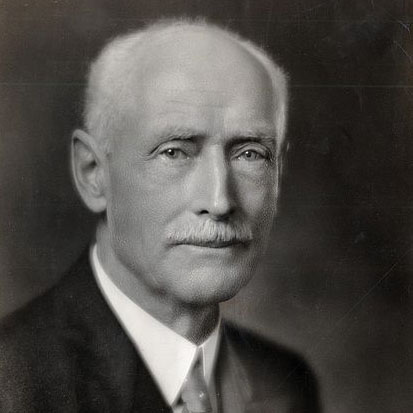
Carl Emil Seashore
Objects in the Database

Seashore Measures of Musical Talents 1939: Series-A-1-Pitch Audio

Seashore Measures of Musical Talents 1957: Series-B-1-Pitch Audio
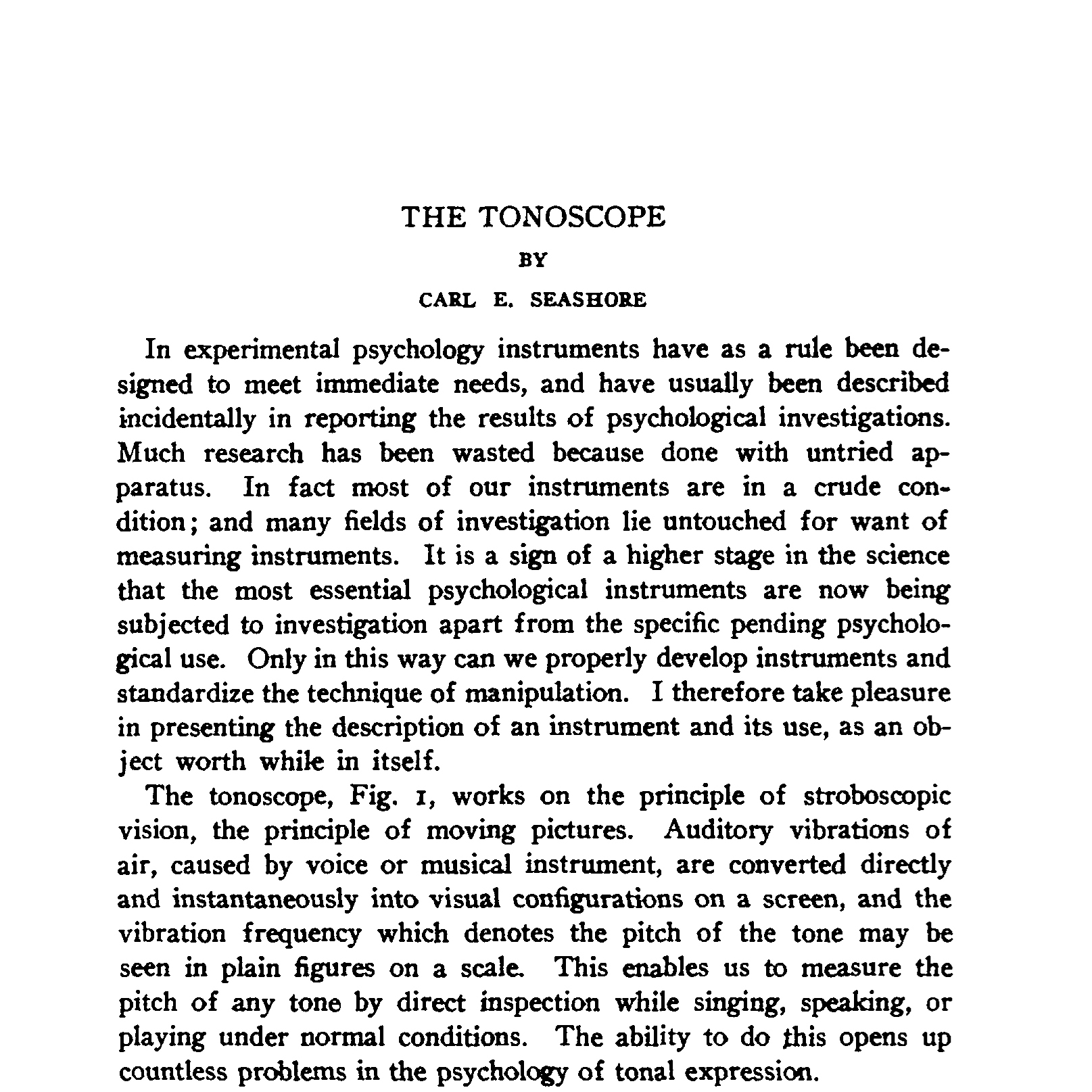
The tonoscope Texts
The vibrato: Introduction Texts
Elementary experiments in psychology Texts
In search of beauty in music Texts
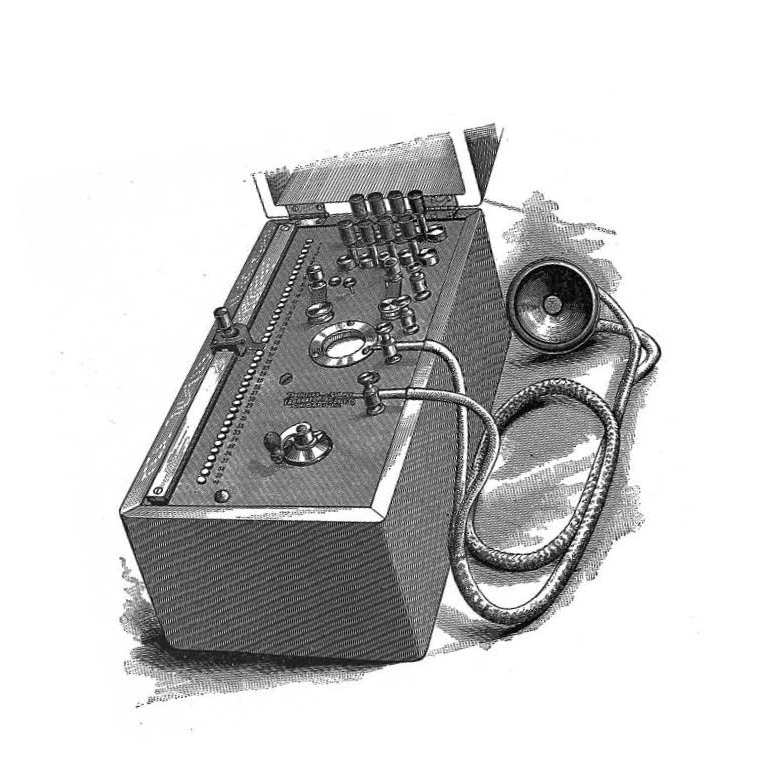
An audiometer Texts
Psychology of music Texts
The psychology of musical talent Texts
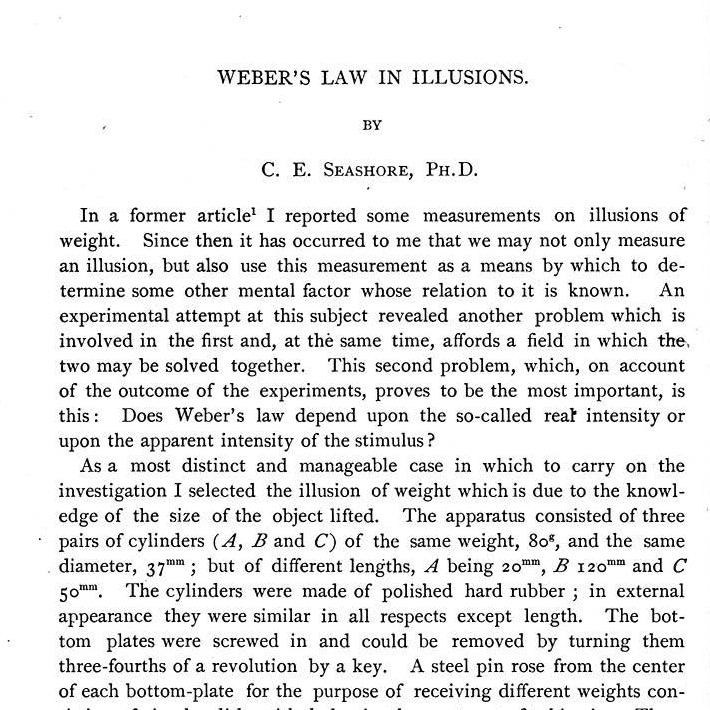
Weber’s law in illusions Texts
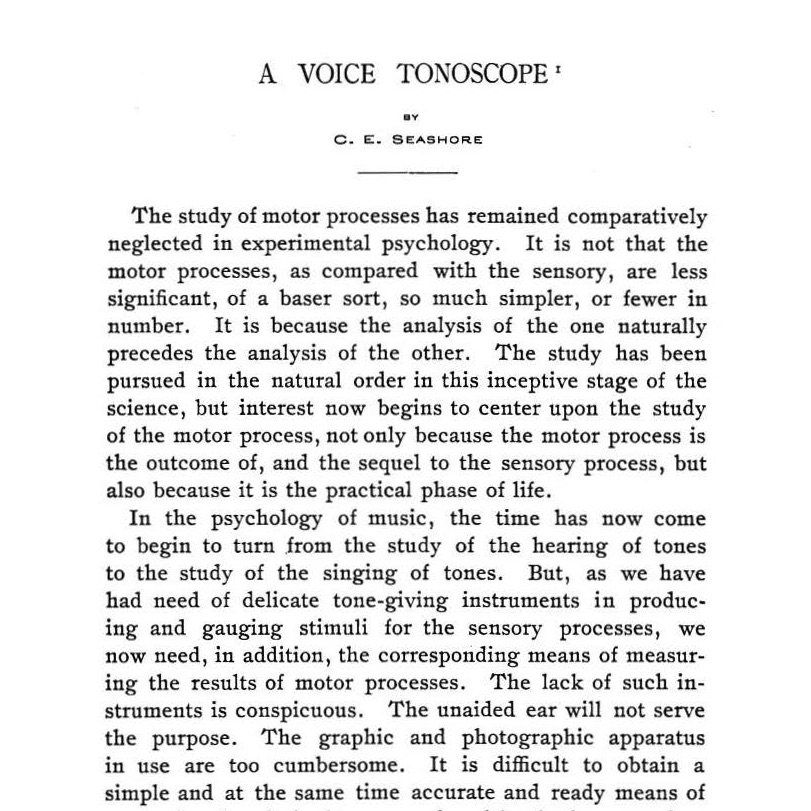
A voice tonoscope Texts

Cite this entry: “Carl Emil Seashore.” Person. Sound and Science: A Database for Sources in the History of Acoustics. Last modified 23 November 2026. https://soundandscience.net/id/10514.
Carl Emil Seashore
Carl Emil Seashore was born Carl Emil Sjöstrand on January 28, 1866, in Mörlunda, Sweden, and died on October 16, 1949, in Lewiston, Idaho.
Seashore’s family emigrated from Sweden to Iowa when he was three years old. Seashore attended Gustavus Adolphus College in St. Peter, Minnesota, a Swedish Lutheran institution where he studied mathematics, music, classical languages, and literature. After earning his bachelor’s degree in 1881, Seashore attended the newly founded Graduate Department of Philosophy and Psychology at Yale University. In 1895, he received his PhD in psychology under Edward Wheeler Scripture with a dissertation on the role of inhibition in learning. In 1897, Seashore became assistant professor of philosophy at the University of Iowa, where he served as Graduate College dean from 1908 until he retired in 1946.
Seashore was interested in educational psychology and the psychology of music and art, especially in audiology, speech, stuttering, and the measurement of scholastic motivation and aptitude. In 1919, he developed the Seashore Test for Musical Ability, which is still used in US schools today.
Seashore became president of the American Psychological Association in 1911, and was awarded honorary degrees by Yale University in 1935 and the Chicago Musical College in 1939. He was a member of the Acoustical Society of America and the American Musicological Society. He was also elected to the National Academy of Sciences and made an honorary fellow of the British Psychological Society.
Key publications:
- Seashore, Carl Emil. 1899. “New Psychological Apparatus, II: An audiometer.” Studies in Psychology from the University of Iowa 2 (1899): 158-163.
- Seashore, Carl Emil. “A Voice Tonoscope.” University of Iowa Studies in Psychology 3 (1902): 18-28.
- Seashore, Carl Emil. Elementary Experiments in Psychology. New York: Henry Holt and Company, 1908.
- Seashore, Carl Emil. “The tonoscope.” Psychological Monographs: General and Applied 16, no. 3 (1914): 1–12.
- Seashore, Carl Emil. The Measurement of Musical Talent. New York: G. Schirmer, 1915.
- Seashore, Carl Emil. Psychology in daily life. New York: Appleton, 1918.
- Seashore, Carl Emil. The psychology of musical talent. Boston, New York, etc.: Silver, Burdett and Company, 1919.
- Seashore, Carl Emil. “Introduction.” In: Studies in the Psychology of Music 1: The Vibrato. Iowa: Iowa State University Press (1932), 7-13.
- Seashore, Carl Emil. Psychology of Music. New York/London: McGraw-Hill, 1938.
- Seashore, Carl Emil. In search of beauty in music: a scientific approach to musical esthetics. New York: Ronald Press, 1947.
Sources:
- Addis, Laird. “Seashore, Carl Emil” In The Biographical Dictionary of Iowa. University of Iowa Press, 2009. [Online version]
- Carl Emil Seashore in the Virtual Laboratory Project of the Max Planck Institute for the History of Science
- Short Biography by Judith Duchan (University at Buffalo) on her Website “A History of Speech – Language Pathology”
Compiled by JH
Cite this entry: “Carl Emil Seashore.” Person. Sound and Science: A Database for Sources in the History of Acoustics. Last modified 23 November 2026. https://soundandscience.net/id/10514.
Join the Project
To contact us, please write to ofni.ecneicsdnadnuos@tcatnoc




© 2015 – 2026 Humboldt-Universität zu Berlin