Video
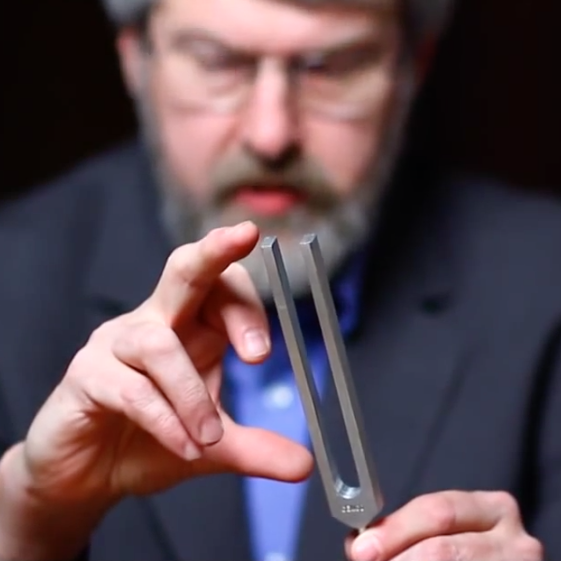
Introduction to tuning forks from the National Museum of American History
When you play this video, data (including your IP address) is transmitted to YouTube (Google). Google privacy policy

Cite this entry: “Introduction to tuning forks from the National Museum of American History.” Video. Sound and Science: A Database for Sources in the History of Acoustics. Last modified 23 November 2026. https://soundandscience.net/id/13002.
Introduction to tuning forks from the National Museum of American History
Historical Context
Technically, a tuning fork is an acoustic resonator. When struck it produces several tones – a fundamental and at least one harmonic – but the fork’s shape tends to minimize the harmonics and within a few seconds only the fundamental can be heard. The tone a fork makes is determined primarily by the length of its “tines” (or prongs). Longer tines vibrate more slowly and thus produce a lower tone. Shortening the length of the tines allows them to vibrate faster and thus produce a higher sound.
The invention of the tuning fork is generally credited to the British musician, John Shore, in 1711. Shore used his fork as a pitch standard to tune musical instruments, a task for which they are still used today. In the 19th century, advances in manufacturing made it possible to create extremely precise tuning forks, which were made in sets and used as tone generators to identify and measure other sounds. By the last decades of the 19th century, tuning forks were among the most precise of all scientific instruments. Specialized techniques were developed to use them for measuring different kinds of vibrations, and they were frequently used as high-precision timing standards. Albert Michelson, for example, used light reflected from the vibrating tines of a tuning fork to make his historic measurements of the speed of light.
In the 20th century, the development of electronic technologies for measurement and precision timing quickly replaced technologies that employed mechanical tuning forks. One notable exception has been the introduction, around 1960, of tiny quartz tuning forks in high-precision watches. Maintained in motion by batteries, the resonating forks far exceed the accuracy of conventional mechanical watches.
Source: Steven Turner; Curator, Physical Sciences, National Museum of American History, Smithsonian Institution.
Further information on the Science Teaching Collection and the Smithsonian National Museum of American History can be found here.
Cite this entry: “Introduction to tuning forks from the National Museum of American History.” Video. Sound and Science: A Database for Sources in the History of Acoustics. Last modified 23 November 2026. https://soundandscience.net/id/13002.

Join the Project
To contact us, please write to ofni.ecneicsdnadnuos@tcatnoc




© 2015 – 2026 Humboldt-Universität zu Berlin