Artefacts
De La Tour’s siren, Science Teaching Collection

Cite this entry: “De La Tour’s siren, Science Teaching Collection.” Artefact. Sound and Science: A Database for Sources in the History of Acoustics. Last modified 23 November 2026. https://soundandscience.net/id/13502.
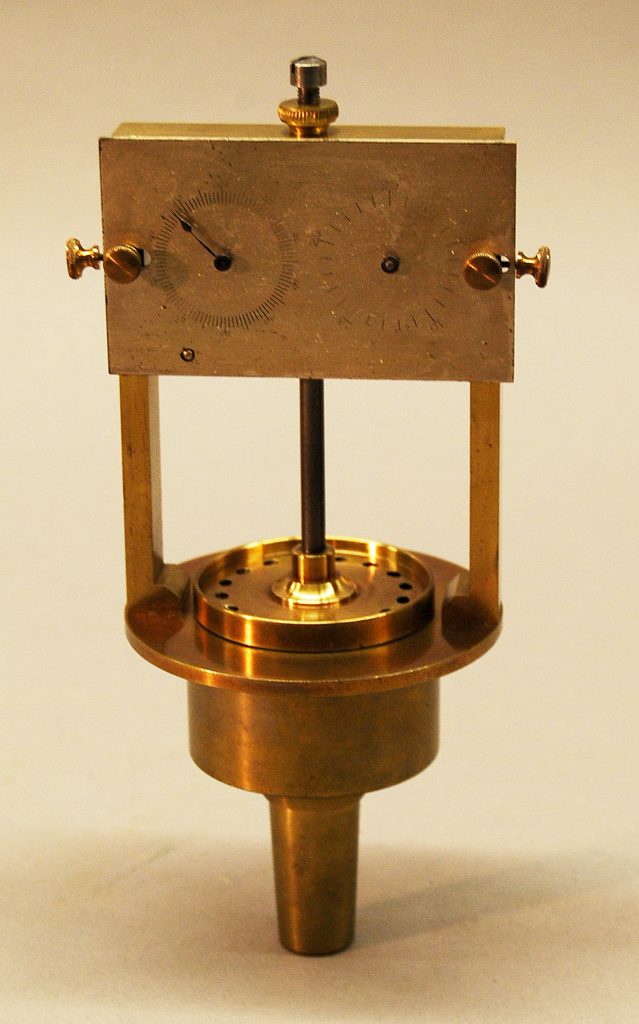
De La Tour’s siren, Science Teaching Collection
Cagniard de la Tour invented his “Sirène” in 1819 and then used it to answer a variety of scientific questions. He used it not only to measure musical frequencies, but also the speed of a mosquito’s wings (10,000 flutters per second). He showed that it worked as a warning signal on ships and reported that it even made a sound underwater (using water pressure instead of air pressure). His siren was later used to measure the speed of sound in water, and it was this property of “being sonorous in the water” that caused him to call it a Siren.
One of the advantages of de la Tour’s design was that it was simple and compact. The same air pressure that made the sound was also used to drive the rotating disc. This was accomplished by drilling the holes in the two discs obliquely, at such angles that the upper disk begins to rotate automatically, much like a turbine, when air pressure is applied. However, this same feature caused one of the siren’s problems. Because it was driven by the same air pressure that produced the sound, producing higher tones on the siren required increased air pressure – which meant that the sound would also be louder. The opposite is true of low notes. Overall, sirens of this design are soft on low notes and shrill on high ones. In terms of making actual measurements, the siren is also limited by its reliance on human hearing. Under ideal conditions, a skilled researcher could use de la Tour’s siren to distinguish between sounds that were a fraction of a wavelength apart.
Source: Steven Turner; Curator, Physical Sciences, National Museum of American History, Smithsonian Institution.
Cite this entry: “De La Tour’s siren, Science Teaching Collection.” Artefact. Sound and Science: A Database for Sources in the History of Acoustics. Last modified 23 November 2026. https://soundandscience.net/id/13502.

Join the Project
To contact us, please write to ofni.ecneicsdnadnuos@tcatnoc




© 2015 – 2026 Humboldt-Universität zu Berlin